Call for papers
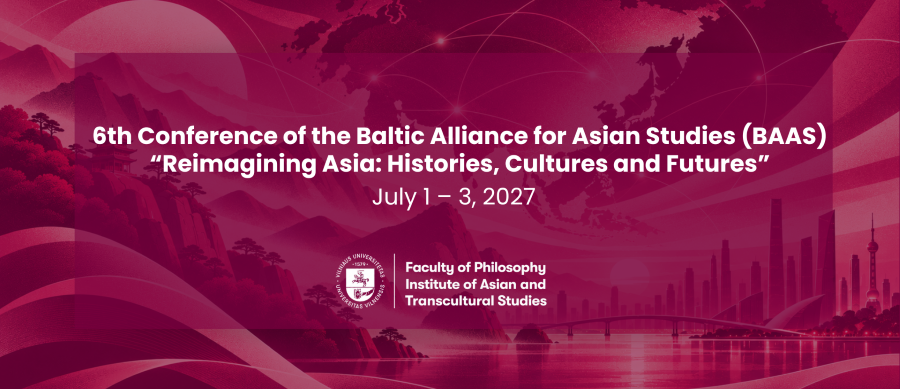
The Institute of Asian and Transcultural Studies (Faculty of Philosophy. Vilnius University) invites proposals for conference papers for the 6th Baltic Alliance for Asian Studies (BAAS) conference ”Reimagining Asia: Histories, Cultures and Futures“.
Asia has long been imagined, interpreted, and represented through diverse historical, cultural, and political contexts. European and colonial imaginaries have played a significant role in shaping understandings of the region, often producing stereotypical representations structured around binary oppositions. Yet Asia encompasses a multiplicity of societies, histories, and cultures whose boundaries and meanings have been continually negotiated both within the region and through its transcultural and transnational interactions. These processes of negotiation are shaped by specific historical and ideological contexts, as well as by internal and external power relations that influence the construction of national identities, cultural formations, and notions of belonging. At the same time, diverse systems of knowledge, cultural practices, and social and political movements across Asia have generated alternative ways of interpreting the past, understanding the present, and envisioning the future. Amid ongoing geopolitical shifts, social transformations, and changing global power relations, there is a growing need to revisit established assumptions and develop new perspectives on Asia and the Middle East. Reimagining Asia thus entails more than reconsidering existing representations: it invites critical reflection on the histories, cultures, and social relations that have shaped the region, on the ways Asia is understood in the present, and on the multiple futures that can be envisioned.
The 6th BAAS conference ”Reimagining Asia: Histories, Cultures and Futures“ welcomes contributions from across the humanities and social sciences, including cultural studies, anthropology, sociology, history, political science, literary studies, religious studies, and related fields. We invite papers employing diverse theoretical frameworks and methodological approaches to explore Asia and the Middle East across historical periods and contemporary contexts. We particularly welcome interdisciplinary and comparative perspectives that examine connections within Asia and between Asia and other regions.
Possible topics include, but are not limited to:
• Asian History and Historiography: colonial and postcolonial histories, historical memory.
• Traditional Systems of Knowledge: philosophical traditions, histories of ideas, knowledge systems.
• Religious Studies: religious traditions, lived religion, new religious movements, religion in relation to politics and society.
• Anthropology and Sociology of Asia: social structures, community, everyday life, social movements, social change.
• Gender and Sexuality Studies: gender relations, masculinities and femininities, sexuality, queer studies, the intersections of gender, culture, and society.
• Migration and Diaspora Studies: migration, transnationalism, diaspora, displacement, migrant identities.
• Literary and Textual Studies: Asian literatures, comparative literature, textual traditions, translation.
• Film, Media and Visual Culture: cinema, television, animation, digital media, visual arts, popular culture, music, performance.
• Asian Politics and International Relations: political institutions, ideologies, nationalism, regional relations, Asia's role in global affairs.
• Baltic Perspectives on Asia: historical connections, comparative perspectives, cultural representations, contemporary encounters.
Submissions:
Abstract proposals for individual papers should be in English and no more than 250 words long and include a 50-word author biography.
Proposals for pre-formed thematic panels are also welcome. Each panel must consist of three papers, with each paper proposal adhering to the same submission guidelines: it must be written in English and must not exceed 250 words, including a 50-word author biography.
The deadline for submitting both individual paper proposals and proposals for pre-formed thematic panels is 15 December 2026.
Please send your abstract proposals to the conference organizers at
Decisions on acceptance will be communicated in late January 2027.
Registration:
Conference registration fee 70 EUR (faculty members) and 35 EUR (students, including PhD students).