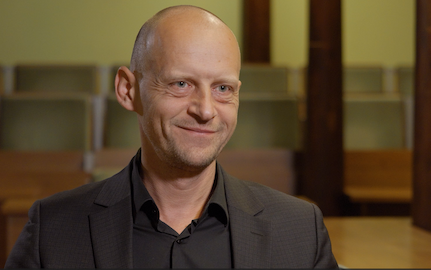
2025 m. gruodžio 9 d. kviečiame į Varšuvos universiteto docento dr. Przemysławo Bursztykos viešas paskaitas.
Vizito metu docentas skaitys dvi paskaitas anglų kalba „Where Lies Eastern Europe?“ ir „How Should We Understand Philosophy of Culture?“. Maloniai kviečiame dalyvauti.
Doc. dr. Przemysławas Bursztyka yra Varšuvos universiteto Kultūros filosofijos katedros vedėjas, kultūros filosofijos žurnalo „Eidos“ vyriausiasis redaktorius.
****
APIE PASKAITAS
„Where Lies Eastern Europe?“
Paskaita organizuojama bendradarbiaujant su VU Istorijos fakultetu
VU Istorijos fakultetas (Universiteto g. 7, Vilnius), 211 auditorija, 15 val.
“My talk is an attempt at resemantization of the category of Eastern Europe. It will be done in three steps: deconstructive, constructive and projective. In accordance with the dominant view Eastern Europe is a cultural-historical construct. It is an effect of a whole set of cultural operations initiated, in a systematic and very conscientious way, in a particular epoch, namely the Enlightenment and then conducted for many centuries; and for specific reasons. The main motivation was to provide (Western) Europe, which itself was in the making, with a negative mirror-image of itself. This process culminated in the post-war period. Thus, the first step will be a deconstruction of that image by means of exposing the above-mentioned cultural operations and their colonialist origins. What is striking is that nowadays there is a clear confusion as to how Eastern Europe should be delineated geopolitically and geoculturally. So, in the next step I will proceed from putting aside all existing categorizations, to the construction of an image of EE based on axiological (positive) and cultural (negative) criteria. Finally, the third step will be projective in a phenomenological (more specifically, Heideggerian) sense. Here I will defend the category of EE, as well as its reality, as a topo-graphical and ethical category. “
****
„How Should We Understand Philosophy of Culture?“
VU Filosofijos fakultetas (Universiteto g. 9, Vilnius), 304 auditorija, 17 val.
“It seems that that the status of philosophy of culture is notoriously uncertain. It is determined by a double predicament. It concerns both the status of the discipline as well as the objective field of its cognitive interests, namely culture. There is a permanent confusion as to how we should conceive both. I propose a possible response to this double predicament in what I call an apophatic philosophy of culture. The two basic assumptions of this approach are: First, in case of philosophy of culture there is an insurmountable entanglement of the “object” and discipline. There is no separation, no distance between these two. Philosophy, as such, originates from culture and always necessarily refers to it (whether consciously or not); it is culture’s ultimate possibility of self-questioning and self-critique. Second, culture – against all essentialism, against all objectivistic tendencies – is essentially non-objectifiable. It is an all-encompassing, apriorical horizon of all possible meanings and modes of experience – expressed and articulated in more or less comprehensive systems of structuration and symbolic formation, but never reducible either to any of them, or to any potential sum of them. An apophatic philosophy of culture presents culture as such originary horizon of all human creative efforts of meaning-giving. It is fundamentally pluralistic, polyphonic, dynamic, open, but most importantly, tensive. Such perspective has far-reaching consequences for our understanding not only philosophy of culture, but also philosophy as such.”