


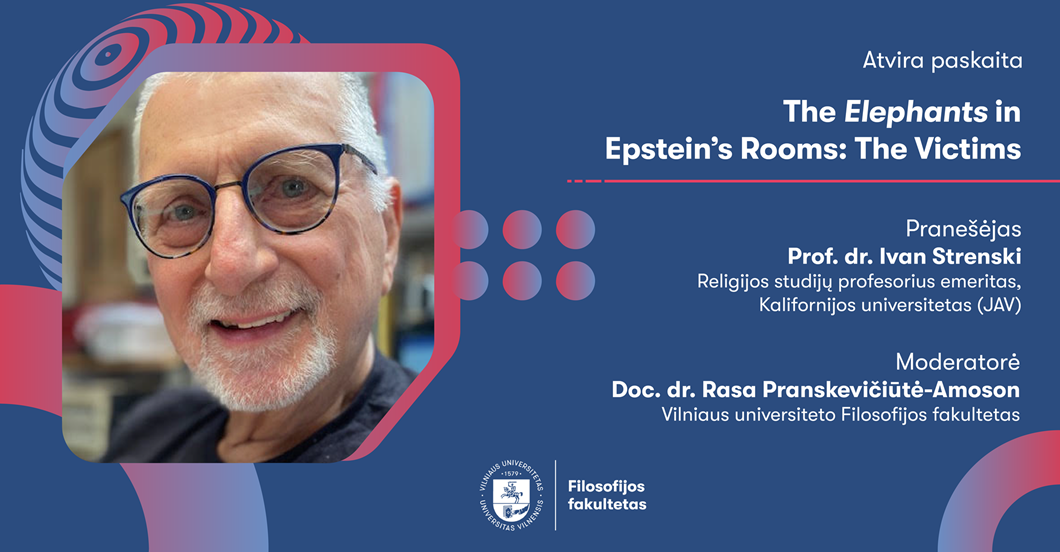
 2026 m. kovo 25 d., trečiadienį, 17.00–18.30 val. vyks nuotolinė Kalifornijos universiteto (JAV) religijos studijų profesoriaus emerito dr. Ivano Strenski paskaita The Elephants in Epstein’s Rooms: The Victims („Drambliai Epsteino kambariuose: aukos“).
Paskaita vyks anglų kalba. Prisijungimo nuoroda.
Apie paskaitą (ENG). The Epstein Affair has finally ripened, but many questions are still unanswered. Among the more troubling are a cluster of issues that engage the ethical and religious dimensions of life in the West. Do our culture’s formative mythologies and religious beliefs, typically taken for granted, influence how and why official law enforcement and political leadership have been slow to take up the cause of Epstein’s victims? More troubling still, are what the general public take for granted responsible for a reluctance robustly to champion the cause of Epstein’s victims?
Although the case of Epstein’s victims reeks of injustice on a mammoth scale, it has not elicited the extraordinary displays of public sympathy, attending such issues as racism, violence against refugees, the Climate Crisis, or Putin’s genocidal assault on Ukraine. Epstein’s victims have not generated popular expressions of sympathy, evident in the viral emergence of fashion items like tee shirts, tattoos, ‘pussy’ hats, or sports caps. Nor are the streets filled by demonstrators, chanting catchy slogans or splashing powerful messages on their posters of protest. Why? I shall argue that the reasons lie in remarkable power of the unremarkable – the taken for granted mythic and religious attitudes assumed in our culture. This renders Epstein’s victims “the elephants in the room” – we all know the victims are there, but we resist saying so.
Apie lektorių (ENG). Ivan Strenski, Distinguished Professor or Religious Studies, Emeritus, University of California, Riverside, Doctor Honoris Causa (Lausanne) as authored 21 books, most recently Why Politics Can’t Be Freed from Religion: Radical Interrogations of Religion, Power and Politics (Blackwell Manifesto’ Series, 2009) (with Arabic translation, 2016), Muslims, Islams, and Occidental Anxieties: A Conversation about Islamophobia (Ethics International Press, 2022), and How to Do Things with Myths: A Performative Theory of Myths and How We Got There (Equinox, 2024). Author of over 100 articles and chapters in books, his work has appeared in such leading journals as Religion, Journal of Law and Religion, Politics, Religion and Ideology. His latest research interests focus on changing relations between modern politics and religion in Europe and North America.